How to transform your business with AI
October 16, 2026
Building AI has never been easier. Even someone with no technical background can vibecode a working demo in an afternoon.
And yet most companies still don't see the results they want from AI. The potential ROI in the project proposal never turns into live, measured savings. Growing the business still means hiring more people.
The models are good enough. Everything around them is the hard part: finding out what actually needs building, getting it reliable enough for real work, and making sure it gets used.
That is the work I do. I work with leadership to find the bottlenecks, sit with the people doing the work, and build AI systems that improve those processes. Then I stay involved to measure the results and get the team using them.
This is my playbook for integrating AI into a business. Five steps, from finding the first opportunity to making the improvements stick.
1. Investigate: find the process worth improving
I start with the business, before choosing any tools.
What stops you from serving twice as many clients? Where does work pile up? Which part of delivery gets more expensive every time revenue grows?
Those questions give the project a commercial purpose. Then I sit with the people doing the work to understand what actually happens.
Leadership can explain the growth target. The customer support team can explain why an order-status enquiry takes six minutes, three systems and a message to the warehouse.
A process map for that enquiry might look like this:
- Read the customer's message and identify the order.
- Find the order in the internal system.
- Check the carrier's latest tracking information.
- Decide whether this is a routine update or an exception.
- Reply to the customer, or escalate with the relevant information attached.
Now we have something specific to improve. We can see the systems involved, where judgment is required and which cases should stay with a person.
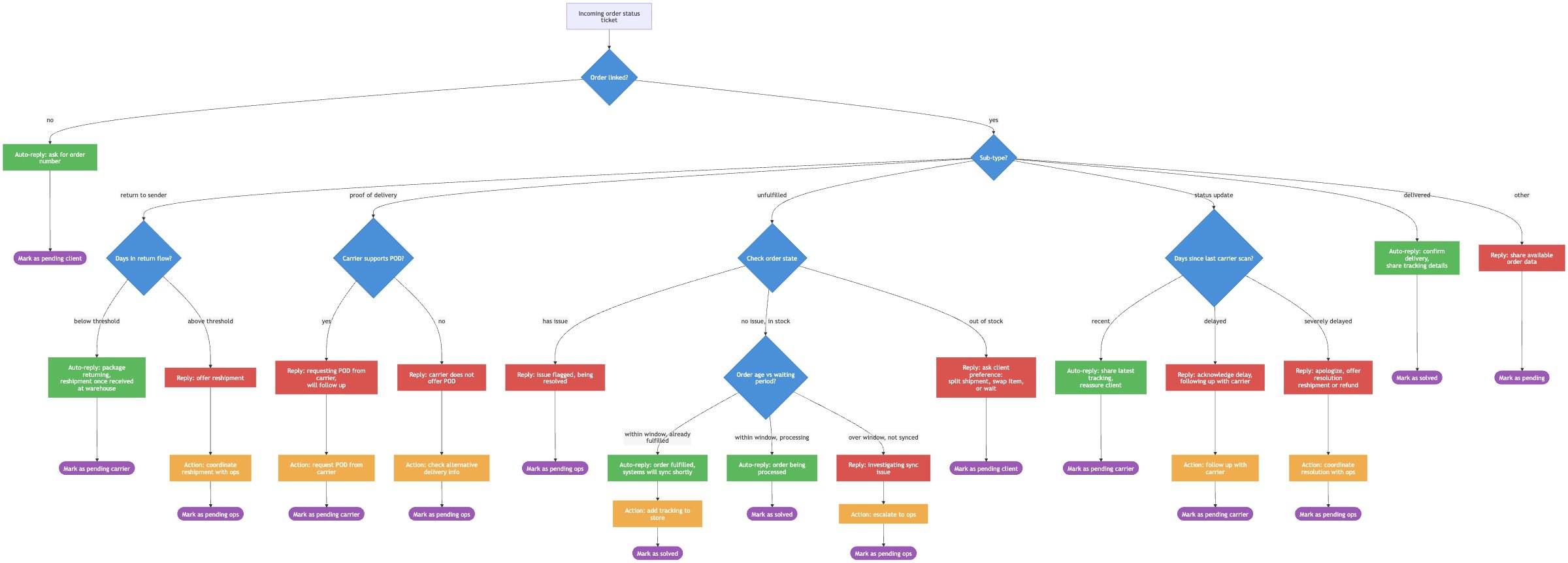
An example of how I map a process with the team. Simplified to keep sensitive details out. Click the image to view it full size.
One question I always ask the team: "What part of your job do you hate?"
I learned to ask this after building a blog writer for a marketing team. I kept improving the output, convinced adoption would follow. It didn't. Eventually, the team told me writing was the part of their job they enjoyed most.
The tool made no meaningful impact. I had solved a problem they didn't want solved.
For your business, the first project should combine meaningful operational value with a problem your team wants fixed.
Put a number on the opportunity
Before approving a build, estimate the time currently spent on the process:
Time per task × monthly volume = monthly hours of work.
For example, a task taking six minutes and happening 3,000 times a month represents 300 hours of work. That is the opportunity size, not a promise that all 300 hours can disappear. Exceptions, human review and the work left around the automation all affect the result.
Recovered hours give you capacity. They become cash savings only when an actual cost is reduced or avoided. If the benefit is more sales, identify how that capacity will lead to additional deals and how you will measure the contribution.
Then compare the expected benefit with the build cost and ongoing cost of running the system.
I map the candidate projects in an impact / effort matrix. Here is an example for a recruitment agency.
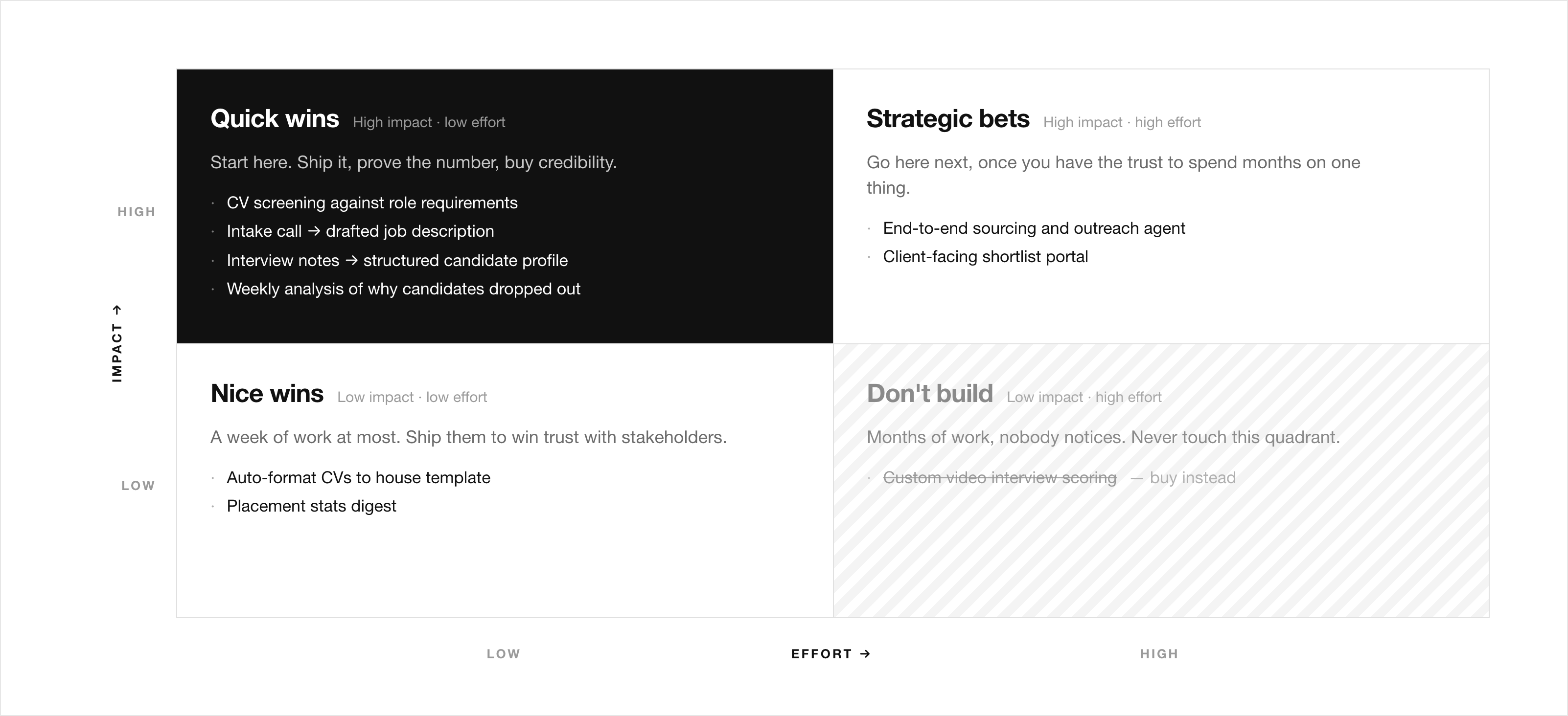
Compare impact and implementation effort before deciding what to build. Click the image to view it full size.
I prioritise projects with clear value, manageable implementation effort and a team ready to use them. A small success earns the trust and operating knowledge needed for the next project.
2. Build: fit the solution to how your company works
You do not need a custom platform for every AI opportunity. You do need a solution that fits the people using it.
I usually work with three levels of implementation.
A shared AI workspace
For a founder or a small leadership team, the right starting point may be an AI workspace containing company context, instructions and repeatable workflows.
It can help prepare proposals, analyse information or produce recurring reports. The person stays involved and asks the AI to do the work.
This can deliver value quickly when only a few people need access and the tasks benefit from direct interaction. It still needs clear rules for what information belongs there and who can access it.
Agents inside your existing tools
When a process is repeatable and starts with a clear event, I look at making it run automatically.
An incoming support ticket, a new enquiry or an order update can trigger the work. The agent gathers information, completes the allowed steps and passes exceptions to the right person.
The team interacts with it through tools they already use, such as their helpdesk, email or Slack. They do not need to learn a new application just to benefit from the system.
This is often the right fit when the same workflow needs to serve an entire department consistently.
Custom software and AI agents on the same foundation
Integrating AI into your business also means taking advantage of how quickly AI lets us build custom software.
Work that used to require a lengthy, expensive development project can now be built and improved much faster. That changes which projects are worth doing. A dashboard or internal tool that was previously too expensive to justify can now be a practical investment.
And once you build that software, more automation becomes possible.
We can connect your existing systems, bring their data into one place and build workflows around how your company actually operates. A creative team can manage briefs, assets and approvals. An operations team can track orders, spot bottlenecks and handle exceptions without jumping between spreadsheets and five different tools.
The dashboard and the AI agents can share the same foundation: a backend running on a server and a database, with connections to your existing systems. The dashboard gives people a way to see and manage the work. The agents use that same data and those same connections to carry out tasks.
For example, an agent can flag an order that needs attention, gather the relevant information and prepare the next action. Someone reviews it in the dashboard and approves it. The agent carries out the approved action, and the result appears in the same place. Alongside it, a live dashboard tracks the work the agent completes, the time saved against the manual baseline and the estimated financial return. Your team can manage the work and see its impact in real time.
Each part makes the other more useful. Bringing data together for a dashboard gives agents better information to work with. Building an agent's connections to your systems gives the dashboard more information and actions to expose to your team. You are building on one foundation rather than starting from scratch with every new tool.
This is why I look at custom software and AI together. Some improvements come from agents doing the work. Others come from finally having the right information and tools in one place. Together, they open up processes that would be difficult to automate with a standalone chatbot.
Before committing, you should be able to answer: What does my team need to see, what work should they be able to do here, and which steps should run automatically?
3. Measure: prove that the system works
A successful demo is not enough evidence to put a system in charge of a business process.
Before building, I capture the baseline: time per task, volume, error rate and any service metric we want to improve. Without the before, it is difficult to prove the after.
Then I measure two things separately: whether the system does the work correctly, and whether it improves the operation.
Quality: can we trust the work?
The tests need to reflect the actual task. For an order-status agent, that means checking whether it finds the right order, uses current information, follows company policy and escalates exceptions correctly.
I test representative cases before launch, including difficult cases and missing information. The acceptable error rate depends on the consequence of an error. Drafting an internal summary and approving a refund need different levels of control.
Where a mistake has a material consequence, I keep human approval in place until there is enough evidence to justify greater autonomy. A good test score alone does not establish that.
Once the system is live, we need a record of what it did and why, user feedback and regular review of failures. That gives us a concrete basis for improving it.
Business impact: is the process better?
The operating view should show:
- How much eligible work the system actually handles.
- How often people need to review, correct or redo its work.
- The time saved after accounting for that human effort.
- What happened to response times, throughput and service quality.
- The ongoing cost of running and supporting it.
A system that produces thousands of answers but creates hours of checking may have very little value. Measure the whole process.
I bring these measures together in an ROI dashboard so leadership can see how the programme is performing.
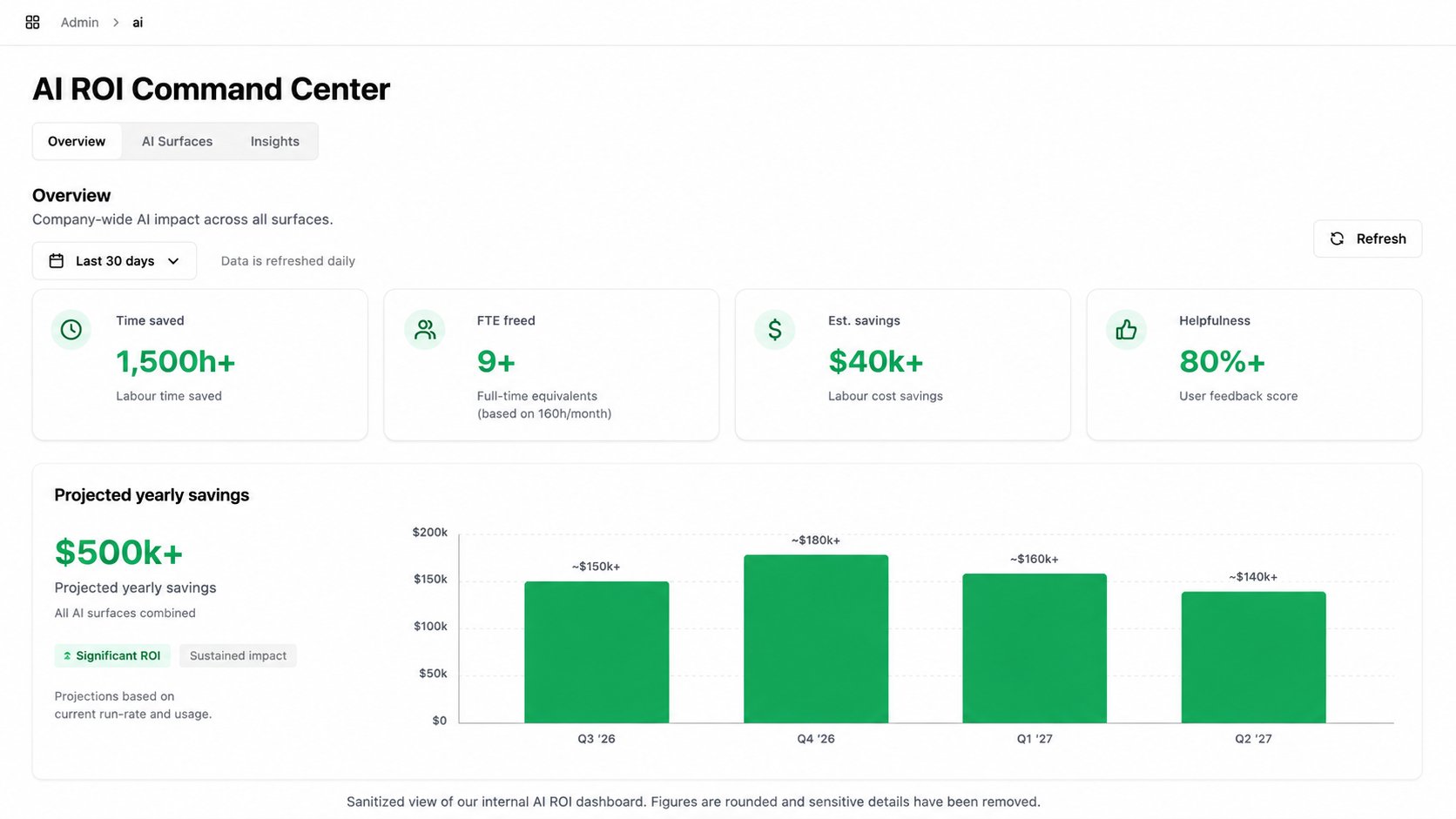
An example of how I present AI performance and ROI. Sensitive details have been removed; figures shown are illustrative, not a claim about your expected results. Click the image to view it full size.
I make reviewing failures part of the operating routine. The same issue appearing repeatedly should become a specific improvement task with an owner.
4. Drive adoption: make it part of daily work
A forecast based on 10,000 tasks a month means little if the team only uses the system for 200 of them.
Adoption belongs in the implementation plan and budget. It cannot be left to an announcement email after launch.
I run regular sessions with the department owner to see how the system is being used, what is missing and where people still fall back to the old process.
With the team, I use workshops built around real work. People bring their own cases, try the system and show each other what works. This also exposes problems that a polished demo will never reveal.
When someone reports a problem, fix it quickly and tell them what changed. That feedback loop teaches people that speaking up is worth their time.
As the owner, your role is to give the team time to learn, make the new process clear and explain what the recovered capacity is for. Faster client responses, less backlog or more time on complex cases are outcomes people can understand.
Share the results with the team as well as leadership. The people helping improve the system should see the difference their involvement makes.
5. Establish ownership: make the improvement last
The business should be able to keep operating when the person who built the system is unavailable.
That requires more than handing over some code. Someone needs to own performance, handle failures, approve changes and decide what to improve next.
Depending on your business, that person may be an internal hire, an existing employee with training or an external partner responsible for ongoing management.
I look for people who understand both systems and people: technical enough to investigate problems, close enough to the operation to recognise what matters, and able to work with the team.
Whichever arrangement you choose, your company should retain access to its systems, documentation and operating history. You should know who to call when something breaks, how to pause an automation and how a handover would work.
An ongoing partnership should earn its place through useful improvements and reliable operation. Your business should have options as its needs change.
Where I would start in your business
I start with a company-wide audit. I talk to leadership and the people doing the work, map the processes across departments and measure where time and effort are going.
Then I rank the opportunities by impact and implementation effort. That gives us a clear view of what is worth building, what can wait and where the biggest opportunities sit across the business.
We start with the low-hanging fruit: high-impact improvements that are relatively straightforward to implement. Get those live, measure the results and build trust with the team. Then use what we learn to move into the larger opportunities, building on the systems and data we already have in place.
That is how I approach AI transformation: investigate, build, measure, drive adoption and establish ownership. The audit sets the priorities. Each implementation delivers on them and informs what comes next.
If you want to understand where AI and custom software can make the biggest difference in your company, book a call. We can discuss your operations and what a company-wide audit would involve.